By Atul Singh and Shashi Chinthakindi.
In our Engineering Energizers Q&A series, we spotlight the engineers tackling Salesforce’s toughest technical challenges. Today, we feature Atul Singh, Principal Architect at Salesforce, whose team faced a seemingly impossible mission: replace MuleSoft’s aging observability platform, migrate 39 petabytes of telemetry, and keep production monitoring operational throughout the transformation. With nearly 3,000 monitoring clusters, persistent operational challenges, incompatible backend architectures, and customer-facing functionality that could not be sacrificed, the stakes could not have been higher.
Explore how the team rebuilt MuleSoft observability on Salesforce’s Hyperforce, consolidated thousands of monitoring clusters, preserved backward compatibility, safeguarded telemetry through automated validation, and orchestrated customer cutovers across more than 12 regions.
What made MuleSoft’s legacy observability architecture so difficult to operate and scale?
As MuleSoft grew, operating the legacy observability architecture required increasingly sophisticated management across nearly 3,000 independently provisioned monitoring clusters. Managing this expanding footprint while maintaining high availability created complex infrastructure demands, prompting a shift toward a more modern, streamlined platform designed for long-term scalability and operational efficiency.
Our team supported observability, metering, and billing across MuleSoft environments spanning CloudHub virtual machines, Kubernetes containers, and hybrid deployments. These included monitoring capabilities delivered through products such as Anypoint Monitoring, as well as observability, metering, and billing functionality for several other products such as API Management, Anypoint Runtime Manager, Object Store v2 and Anypoint MQ, Anypoint Visualizer, etc.
We needed to stabilize the existing platform before we could replace it. Rather than separating maintenance and migration into different teams, we reorganized ownership around horizontal capabilities such as ingestion and logging. Each team became responsible for maintaining its portion of the legacy system while building and migrating the replacement. We also replaced ad hoc production fixes with systematic investigations and root cause analysis for production issues. Instead of repeatedly treating symptoms, we focused on preventing the same failures from recurring.
Within approximately six weeks, incidents began declining. That stability gave us the breathing room to rebuild MuleSoft observability on Hyperforce without abandoning the platform customers still depended on.
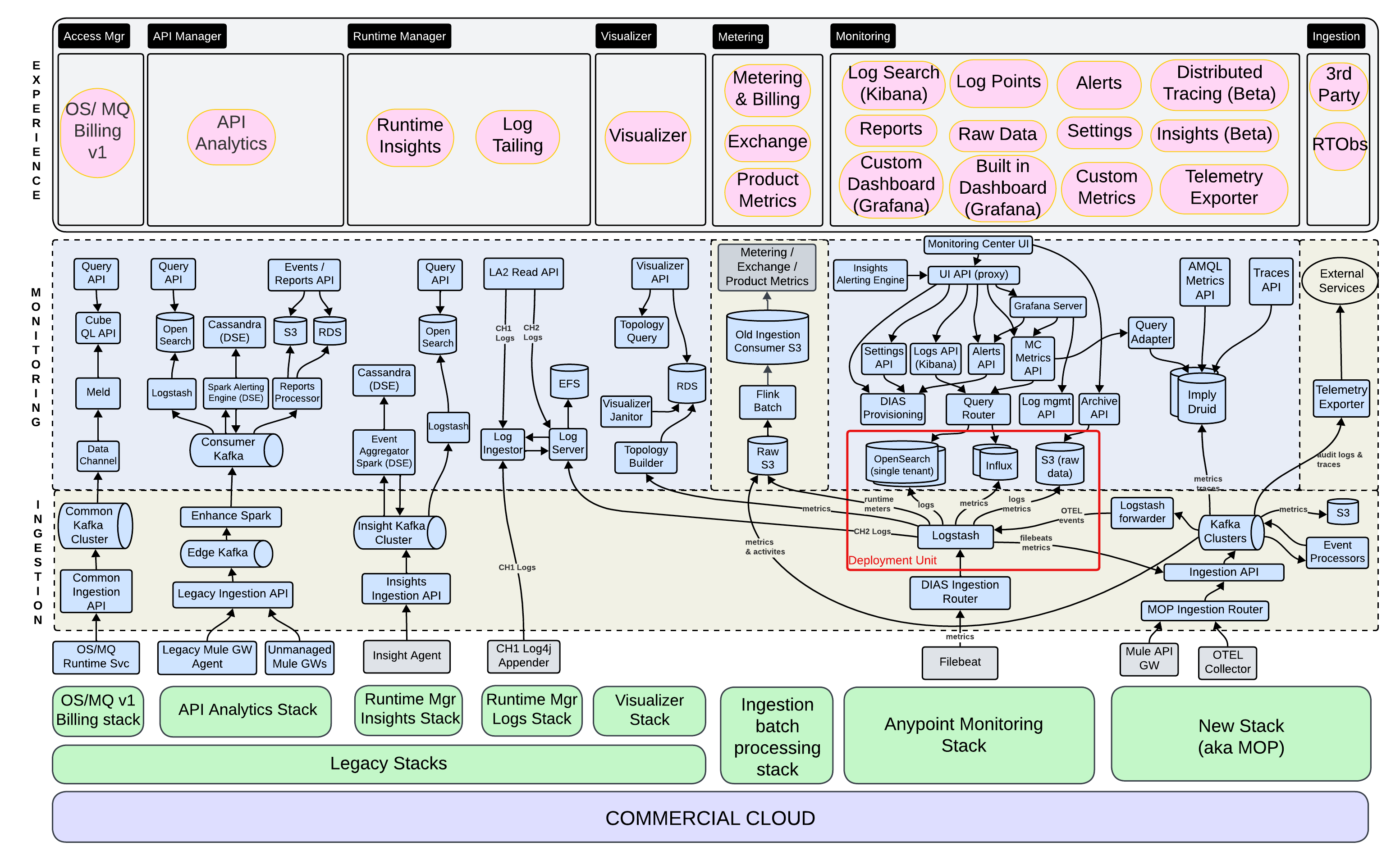
Legacy single-tenant architecture showing fragmented ingestion and monitoring services.
How did you consolidate nearly 3,000 monitoring clusters into 24 while managing shared capacity?
Consolidating nearly 3,000 monitoring clusters into a few dozen shared environments created a daunting capacity challenge. If too many demanding workloads landed on the same cluster, resource contention could undermine reliability. Yet customers still needed the capacity guarantees their dedicated infrastructure had provided.
We replaced the single-tenant architecture with a shared, multi-tenant observability platform on Hyperforce, driving cluster consolidation by pooling infrastructure while preserving sufficient capacity headroom. The key insight was that customers do not all reach peak utilization simultaneously. Under the legacy architecture, each customer received statically provisioned resources, often leaving substantial capacity unused. With multi-tenancy, we could meet those same guarantees without reserving the sum of every customer’s maximum allocation.
However, sharing infrastructure introduced a new responsibility: distributing workloads intelligently. We spread high-utilization customers across clusters rather than concentrating them in one environment. Automated mechanisms also allowed us to move customers when utilization increased, rebalancing capacity without affecting their monitoring experience. The sole constraint was maintaining data residency within the same region.
Architectural consolidation delivered another benefit. By unifying previously separate ingestion, processing, and storage capabilities, we reduced the number of services and components from 153 to 43. The results were remarkable: nearly 3,000 clusters became just 24, a reduction of approximately 99%. Combined with the simplified architecture, this drove a 5x gain in infrastructure efficiency and dramatically reduced the operational complexity our teams managed.
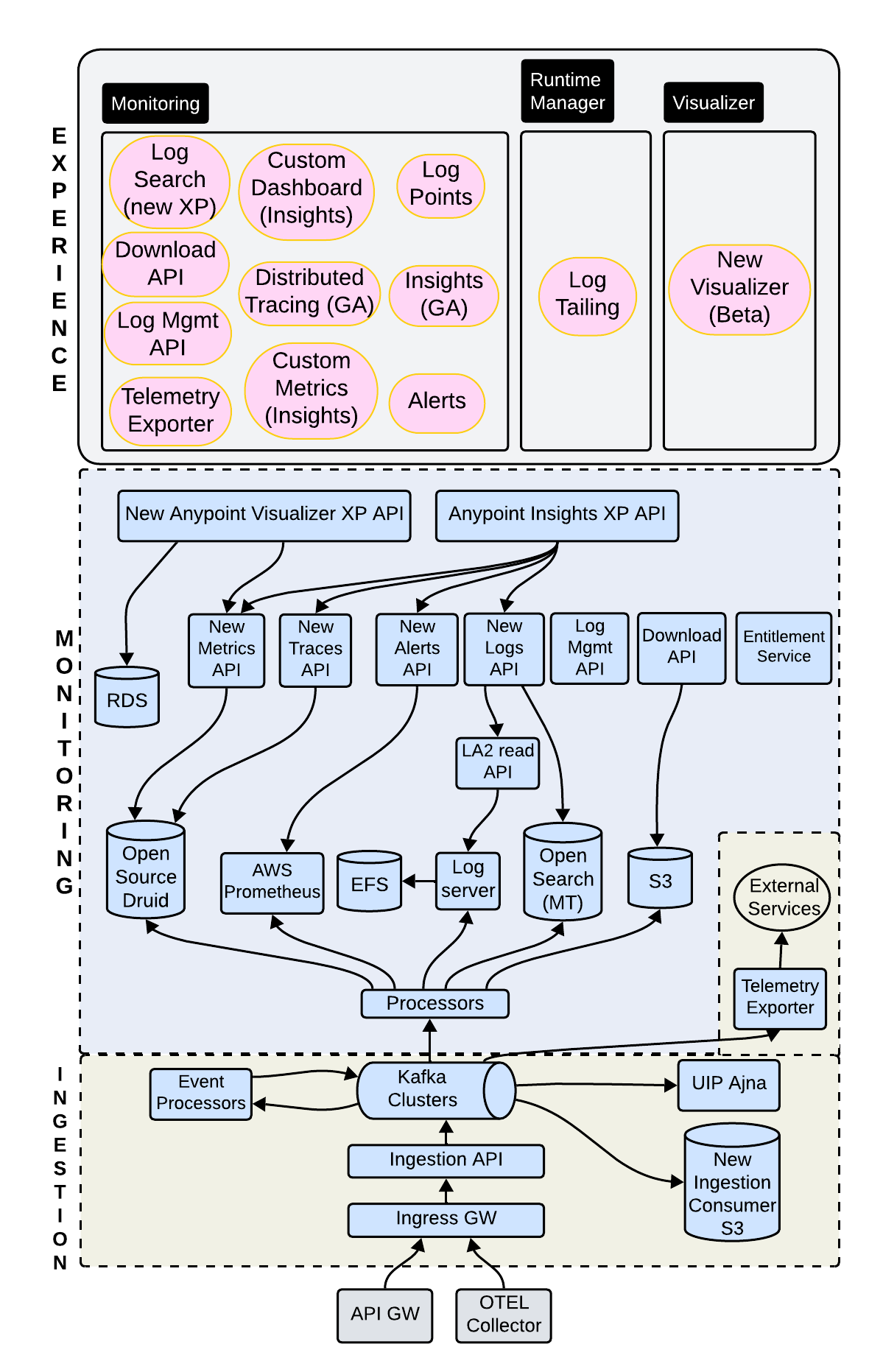
The consolidated multi-tenant observability architecture on Hyperforce, with unified ingestion, processing, and storage pipelines.
How did you replace the storage and query layer while preserving customer APIs?
Replacing the backend of a production observability platform presented an extraordinary contradiction: we needed to change virtually everything underneath while preserving almost everything customers experienced. Existing APIs had to remain compatible, monitoring functionality had to survive intact, and even the user interface needed to look nearly pixel-perfect.
A conventional lift-and-shift migration could not accomplish that. Our replacement platform used a different backend architecture and data formats, requiring us to rebuild services and translate telemetry rather than simply relocate existing components. We standardized instrumentation and telemetry pipelines around OpenTelemetry, replacing fragmented collection and processing approaches with a consistent foundation. This helped simplify the architecture while supporting the transition to Hyperforce.
Backward compatibility remained nonnegotiable. While OpenTelemetry standardized collection and telemetry pipelines, we preserved existing log and metrics query APIs through a translation layer that mapped requests to operations supported by the replacement databases. We mapped existing queries to the new backends, and validation caught the few cases that behaved differently. From the customer’s perspective, familiar functionality continued working even though the underlying systems had changed. We applied the same principle to the user interface, targeting full feature parity and pixel-level consistency. Where we introduced improvements, including enhanced log search, customers received 60 days of access to both experiences so they could provide feedback before transitioning.
The migration also required collaboration with Hyperforce engineers to accommodate MuleSoft-specific networking and private connectivity requirements. These changes supported the replacement architecture without forcing customers to adopt new integrations. Our guiding principle was simple: modernize the entire backend without requiring customers to change how they use the platform.
How did automated validation safeguard 39 petabytes of telemetry during the Hyperforce migration?
Migrating 39 petabytes of telemetry would have been difficult under ideal circumstances. But production could not stop. New logs and metrics kept arriving, customers continued querying historical data, and alerts still needed to fire correctly. We also needed to establish that both systems returned consistent results.
We built the replacement observability platform on Hyperforce, established dual ingestion, and migrated historical telemetry while the legacy environment continued serving customers. Because the two backends used different data formats, the migration also required translation. Our most important safeguard was continuous, automated end-to-end validation. Rather than checking only whether data had arrived, we built validation jobs that compared log and metrics queries, alerts, and notifications across both environments. These jobs examined historical date ranges and generated reports identifying discrepancies between the legacy and replacement systems.
This approach provided broader coverage than simply replaying customer queries. During migration, historical data was not always fully available in the new environment, making direct replay impractical. For selected alerting scenarios, however, we performed shadow validation to confirm that alerts triggered consistently across both systems. The automated checks uncovered discrepancies caused by customer-specific implementations introduced years earlier. Identifying these differences before cutover allowed us to resolve problems that might otherwise have surfaced after migration.
Validation continued throughout data migration, during cutovers, and afterward. In our measurements, the new scalable, multi-tenant stack enabled near-real-time telemetry processing, with P95 telemetry delay falling from multiple minutes to less than one minute. Measured query latencies also improved by 2X.
How did MuleSoft engineers execute Hyperforce cutovers across more than 12 regions without significant disruption?
Rolling out the migration in more than 12 Hyperforce regions introduced another coordination challenge. Customer telemetry remained in its original region during the migration. Each region brought different deployment environments, monitoring requirements, and maintenance windows. Meanwhile, the legacy platform had to remain operational until customers could safely transition to the replacement.
We approached the migration as a carefully sequenced rollout rather than a single cutover. Customers were divided into approximately eight to ten batches, with cohorts organized by region, service, feature, and customer category. We progressed from lower-risk workloads to increasingly complex monitoring workloads. This allowed us to build confidence before transitioning to more demanding environments. Traffic transitions were staged, culminating in router cutovers. Throughout the process, automated validation checked system behavior, while feature flags and rollback mechanisms allowed us to reverse changes quickly when issues emerged.
Coordination was just as important as the technology. Engineering and program teams across the U.S., India, Argentina, and Europe managed releases, maintenance windows, and migration schedules. When blockers appeared, teams coordinated directly to investigate and resolve them. The rollout extended over more than a year, with each successful cohort building confidence for the next. Instead of betting everything on a single high-risk transition, we relied on progressive cutovers, continuous verification, and rapid rollback capabilities.
Ultimately, the greatest achievement was not simply replacing the infrastructure. It was completing an exceptionally complex observability migration to Hyperforce while preserving the monitoring capabilities customers depended on, with minimal disruption throughout the transition.
Learn More
- Stay connected by joining our Talent Community.
- Explore our Technology and Product teams to see how you can get involved.