In our Engineering Energizers Q&A series, we highlight the engineering minds driving innovation across Salesforce. Today, we spotlight Abhi Rathna, Product Management Director for Agentforce, whose team tackled a fundamental engineering contradiction: how do you preserve the stochastic LLM reasoning that makes an AI agent intelligent while guaranteeing that specific outputs render correctly 100% of the time? For critical forms, components, and regulated disclosures, 99% was not enough, yet asking a probabilistic system to behave deterministically meant confronting the very architecture that made the agent powerful in the first place.
Explore how Abhi’s team built the Agentforce Connections layer to separate probabilistic reasoning from deterministic presentation, developed the render: directive to bypass LLM component selection, solved complex sequencing across multi-action and long-running interactions, and extended the architecture across Salesforce-native, third-party, and headless experiences.
What is your team’s mission, and what is it responsible for building within Agentforce?
For some Agentforce experiences, 99% reliability was still failure. A required form had to render. A compliance disclosure had to appear. Yet the agent-generated UX responsible for selecting those experiences relies on stochastic LLM reasoning, meaning the same interaction could produce a rich component one time and text another.
That challenge sits at the heart of the team’s mission. The team owns the Agentforce Connections layer, helping customers deliver rich AI agent experiences across web chat, WhatsApp, SMS, phone, kiosks, and other channels. The work includes agent behavior customization, response customization, multi-channel rendering, and structured JSON responses for headless scenarios. The mission required preserving probabilistic LLM reasoning while creating deterministic boundaries wherever the output could not be left to chance.
Those two requirements naturally pulled in opposite directions. The flexibility that makes agent-generated UX powerful also introduces variability into the rendering decision. For open-ended conversations, that flexibility is valuable. For critical UX moments that must happen every time, it became the engineering problem the team had to solve.
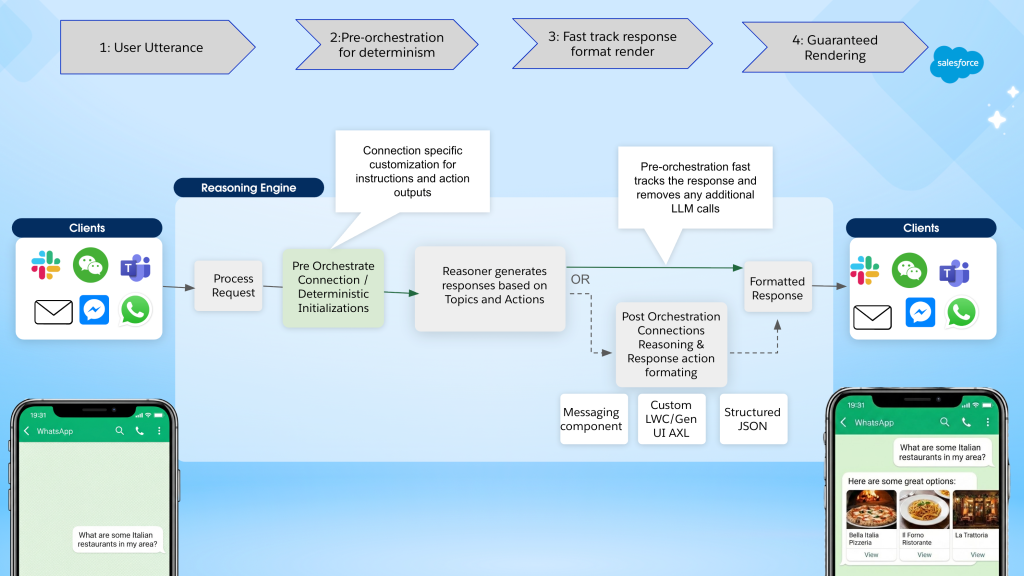
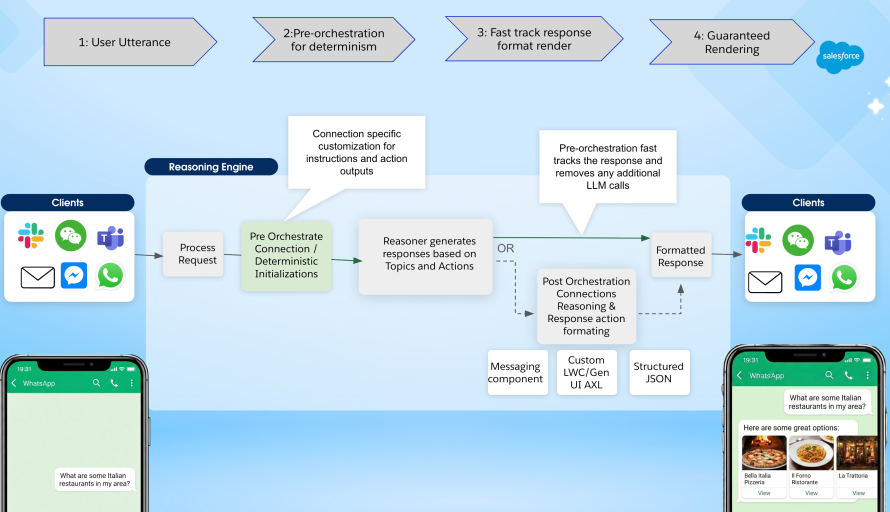
Deterministic control added as part of pre- and post-reasoning orchestration to provide more fine grained control on UX rendering.
What challenges did stochastic LLM rendering create when customers tried to take critical Agentforce experiences into production?
The problem becomes clear when a critical UX component does not render. Imagine an agent that needs to present a form to collect information. The LLM can recognize that need and select the appropriate component, but because the process is stochastic, it will not necessarily make the same rendering decision every time. During testing, the form might appear in one interaction while another returns text or fails to render the form. If that component is essential to completing the interaction, the customer may not be able to take the agent live.
The stakes are even higher for regulated customers, where a disclosure, disclaimer, or other UX element may have to accompany a specific action. The LLM usually showing it is not enough. Builders needed deterministic control over exactly which experience would render for specific actions.
What made separating LLM reasoning from rendering difficult when you needed a 100% deterministic guarantee?
The LLM could not simply be removed from the interaction. The reasoning engine still needed to understand the conversation, determine what the user wanted, and decide which actions should execute. But as long as the LLM also selected how a critical output should render, that decision remained stochastic.
The challenge was finding exactly where to draw the deterministic boundary. The LLM needed to keep reasoning and orchestrating while giving the platform control over one specific decision: how an action configured for deterministic rendering should appear. That led to the render: directive. A builder can associate an action with a specific response format for a particular connection. When that action runs, the Connections layer uses the configured response format instead of asking the LLM to select the UX component.
That is how the 100% guarantee is achieved. The LLM was not made more deterministic; the rendering decision that needed to be deterministic was removed from the LLM entirely. Builders can still customize agent behavior by connection, preserving flexibility everywhere else.
What were the hardest engineering problems in preserving deterministic rendering across multi-action, long-running, and supervised agent interactions?
The hardest problem was determining which output to render and exactly when to render it as multiple actions executed in sequence. An agent might run several actions during a single interaction, while only one is configured for deterministic rendering. Imagine an agent finding the top restaurants in a location and then retrieving the menu from the top result. Several actions may execute, but the platform has to identify the specific action configured for deterministic rendering, attach the correct UX component to its output, and let the remaining actions continue through the non-deterministic path.
Timing created another problem. With long-running or supervised actions, the component can render only after the corresponding action has been approved and executed. Otherwise, the UX could appear before the underlying action completes. The team had to fine-tune the functionality to identify the correct action, use its response, attach the right component, and render it at the correct point in the lifecycle. Getting both selection and sequencing right was one of the trickiest parts of delivering the 100% guarantee.
What complexities did your team encounter when extending deterministic rendering across Salesforce-native, third-party, and headless experiences?
Agentforce is an open platform, so deterministic rendering could not work only with Salesforce-native Lightning Web Components. Customers may use custom React applications, other third-party interfaces, or headless channels where an API consumes structured output. Response formats provide the abstraction to support those scenarios. Customers can define the structured JSON expected by an external experience and associate that response format with the render: directive. Deterministic rendering can then use that format instead of limiting customers to Salesforce-native components.
The same model therefore works whether the output becomes a Lightning Web Component, feeds a custom third-party experience, or is consumed as structured JSON. That flexibility is important because Connections is broader than AI agent UX rendering: it supports third-party components, headless outputs, and different agent behaviors across channels.
What did your team have to solve to make deterministic rendering reliable and auditable for regulated customers?
Regulated customers had two distinct requirements: the required experience had to appear every time, and they needed to prove it did. A financial services firm might require a suitability disclosure to accompany every portfolio recommendation. A healthcare agent might need to prove consent was captured before a procedure was scheduled. For these customers, inconsistent rendering is not a UX issue; it is a potential compliance violation.
Prompt instructions could not solve this. A builder can tell the LLM to always show a disclosure, but stochastic reasoning means it might follow that instruction in 99 out of 100 interactions and skip it in the hundredth. That single miss can trigger regulatory scrutiny. render_as eliminates the uncertainty: the platform renders the required component through the deterministic path every time the associated action fires.
Reliability alone was not enough. Customers also needed observability, proof that the rendering occurred. The team instrumented deterministic rendering events in Agentforce event logs at the per-action, per-session level. Each event captures which action fired, which response format was applied, which connection rendered it, and at what point in the conversation. A compliance officer can query these logs to verify that a specific disclosure rendered in a specific session, or run aggregate reports showing rendering rates across all interactions over a time period.
This combination of platform-enforced rendering plus per-event audit trail gives regulated customers something prompt engineering never could: a guarantee they can demonstrate to an auditor.
Learn More
- Stay connected by joining our Talent Community.
- Explore our Technology and Product teams to see how you can get involved.