In our Engineering Energizers Q&A series, we highlight the engineering minds driving innovation across Salesforce.
Today we spotlight Aastha Goyal, a Senior Manager of Software Engineering, whose team built FastTrack, a production-grade compliance automation platform for Salesforce’s mobile Apple App store and Google Play Store environments that delivers a 24× reduction in audit execution time.
Explore how the team replaced fragile, multi-hour screenshot-driven compliance audits with deterministic, API-based automation and used AI-assisted development to compress the path from system design to production, delivering compliance-grade evidence through APIs never designed for audit workflows while maintaining the Salesforce engineering quality bar.
What is your team’s mission as it relates to scaling compliance automation and developer productivity across Salesforce’s mobile environments?
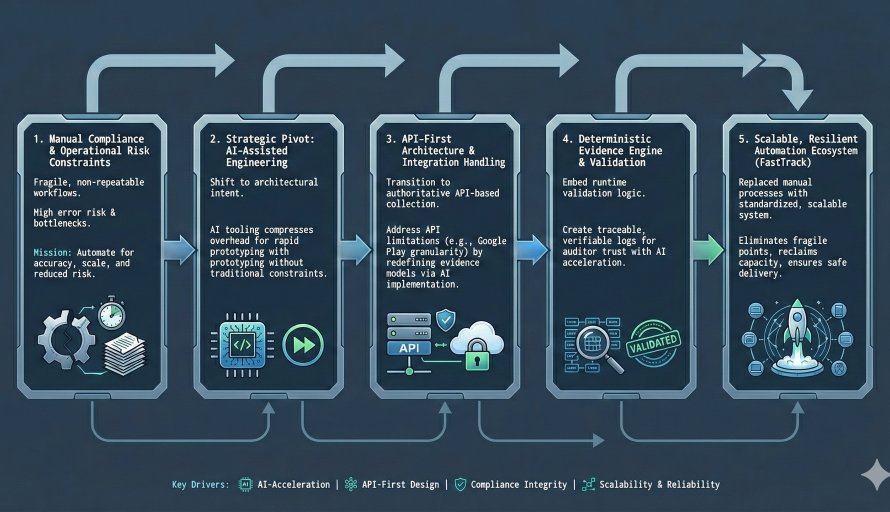
Our team ensures compliance audits across Salesforce mobile environments remain accurate, repeatable, and scalable while minimizing operational risk. As requirements expanded, the team prioritized eliminating fragile manual workflows that consumed engineering time without improving reliability.
The mission evolved to accelerate production system delivery without lowering engineering standards. This shift focused specifically on compliance-critical automation.
AI-assisted development became a core enabler of this strategy. This technology allows the team to focus on system architecture, validation logic, and compliance intent while reducing implementation overhead. These tools ensure platforms like FastTrack reach production quickly and safely, even when engineering resources face constraints.
What workflow constraints shaped the move from manual compliance audits to automated evidence collection?
Manual compliance audits became inherently fragile as mobile environments scaled. Each cycle required engineers to navigate administrative consoles, capture timestamped screenshots, and manually verify permission data. Even small omissions risked invalidating an audit, which created direct business risks for regulated customers.
As the scope of evidence expanded, the process consumed hours per cycle. This methodology depended heavily on individual precision and contextual knowledge. Consequently, operational bottlenecks formed whenever key team members became unavailable.
AI-assisted development changed how quickly the team translates audit requirements into deterministic system workflows. Rather than treating automation as a long-term engineering effort, the team implements architectural decisions around API integration and evidence normalization immediately.
This shift transformed an unsustainable manual process into a scalable automation system. The new approach eliminates fragile touchpoints, reduces risk exposure, and reclaims vital engineering capacity.
What upstream integration constraints shaped how the system handled limitations in the Google Play Console API?
The Apple App Store Connect integration provides the permission granularity required for audit evidence collection. In contrast, the Google Play Console API restricts precise scoping at the application level because it does not expose app-specific user permission data.
The team refused to let this constraint block production automation. Instead, they collaborated with compliance stakeholders to redefine acceptable evidence boundaries. The current solution collects the complete authorized user set within the Google Play Console environment.
AI-assisted implementation accelerates how quickly the team prototypes and hardens alternative evidence models. When constraints surface, the team translates revised compliance requirements directly into functioning system behavior inside FastTrack. This methodology eliminates the need for extended engineering cycles.
This approach preserves audit integrity. It also simplifies both system design and compliance reviews.
What trust and validation requirements shaped how audit outputs were engineered for compliance-grade reliability?
Compliance automation succeeds when governance teams and external auditors accept the evidence. The system functions as a deterministic evidence engine that traces every output directly to authoritative source data.
The design embeds validation logic into runtime execution to enforce fields, timestamps, and permission states. Each audit execution logs the exact API queries to create a transparent, verifiable trail.
AI tooling accelerates the implementation of validation paths and traceability mechanisms within production workflows. This ensures the system enforces compliance correctness programmatically. By making validation a core architectural component, FastTrack delivers reliability at scale.
What system-design challenges shaped the transition from UI-driven automation to API-first production systems?
Early automation efforts often rely on browser-driven workflows that simulate human interactions. These approaches break easily and create maintenance challenges when interfaces change.
Long-term system reliability and scalability remain core design constraints for compliance workflows. The team adopts an API-first architecture to access authoritative data.
AI-assisted development accelerates how quickly the team explores and implements these architectural decisions. API-based automation pipelines allow for rapid iteration and validation. This shift eliminates failures caused by user interface changes and creates a scalable system for compliance automation.
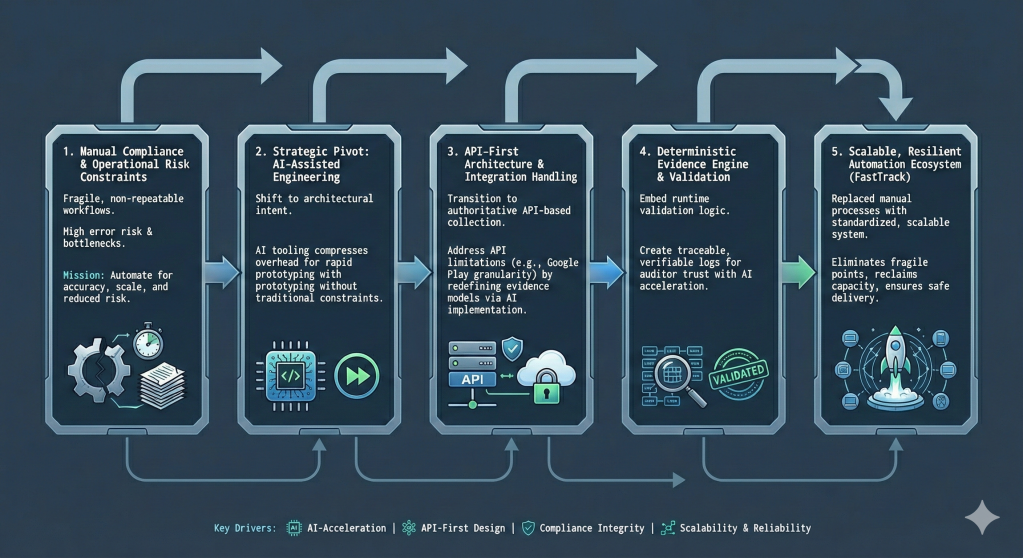
Scaling Compliance: From Fragile Manual Audits to AI-Powered Automation.
What developer-productivity constraints shaped how AI tooling enabled a production system without traditional coding experience?
The initiative originated outside a formal engineering roadmap and succeeded without prior professional coding experience. The system still meets every production quality, security, and compliance standard.
AI tooling shifts development toward architectural intent. It defines integrations, authentication flows, and validation logic while translating those designs into functioning code. Every component undergoes review against engineering expectations to create a rapid feedback loop for refinements.
AI does not replace human judgment. It compresses implementation overhead and narrows the gap between system architecture and execution. This allows the system to reach compliance-grade maturity faster than traditional development approaches.
What operational-risk and scalability constraints shaped how automation replaced manual audits?
Compliance failures impact regulated users and organizational trust. Manual workflows increase risk through human error and inconsistent execution. As mobile environments scale, audit complexity grows while operational capacity stays the same.
AI-accelerated delivery replaces fragile processes before risks grow. Automated evidence collection standardizes execution across teams and removes manual steps. Tasks that once required hours now finish in minutes. This reduces operational exposure and allows compliance automation to scale with the mobile footprint.
Learn more
- Stay connected — join our Talent Community!
- Check out our Technology and Product teams to learn how you can get involved.