In our Engineering Energizers Q&A series, we highlight the engineering minds driving innovation across Salesforce. Meet Emin Gerba, Technology & Product Chief Architect, who guides platform-wide architectural strategy, cross-cloud patterns, and the long-range evolution of the Salesforce product suite, supporting architectural alignment across products and services for over 100,000 customer organizations.
Discover how his team guided unification of key architectural constructs across clouds and technology stacks, including the tenancy and metadata models, to drive a coherent platform foundation that offers increased reliability, security, and scale, while serving as the foundation for the agentic transformation.
What is the Office of the Chief Architect’s mission in shaping a Deeply Unified Platform across Salesforce?
We define and guide the architectural frameworks, principles, and foundational patterns that support Salesforce’s long-term technology evolution. Instead of building or operating platform components directly, we focus on establishing clear architectural direction, partnering with teams to integrate across clouds, regions, and deployment models. By aligning these frameworks with customer needs, we enable engineering groups to build on shared abstractions, avoiding the repeated reinvention of foundational patterns.
Architectural clarity becomes essential at Salesforce’s scale. Our role is to define the shared models and expectations across areas like tenancy, metadata, service interactions, and operational patterns that teams can consistently apply. We work closely with engineering teams and partner with product organizations to ensure these principles are clearly understood, actively applied every day, and reinforced through delivery, so our overall technology stack evolves in ways that strengthen a deeply unified platform rather than fragmenting over time.
Ultimately, we ensure Salesforce’s architecture supports future capabilities, including new data, AI, and agentic experiences. Preserving customer trust and platform stability requires long-term thinking, strong architectural principles, and systems that evolve cohesively over time.
What architectural constraints did platform growth and acquisitions introduce for tenancy, and how did the team establish a consistent model across systems built on different foundations?
Salesforce operates across a broad and evolving set of products, services, and cloud environments, several built on different architectural foundations. Tenancy defines how customer data and workloads are logically partitioned and isolated on the platform. Together with identity, which governs authentication, authorization, and access within those boundaries, it is a critical component of our security model. With the rapid growth in AI and agentic experiences, which rely on data for grounding, personalization, and actions, having a well defined and highly consistent model across the entire stack is even more important.
As the Salesforce product suite grows and acquisitions increase heterogeneity across the ecosystem, the challenge becomes ensuring a shared, consistent understanding of tenancy across all systems. As new products and acquisitions integrate, the Office of the Chief Architect defines architectural standards and expectations, allowing those systems to align with Salesforce’s core tenancy model. This work establishes clear principles for how tenancy boundaries are represented and respected across services built on different architectures, and critically how they relate to each other at runtime, rather than prescribing a single implementation.
These standards give teams a common way to reason about tenancy, regardless of where or how a product develops. This approach reduces fragmentation, enhances security at the very foundational level, supports predictable operation across services, and provides customers with a unified experience as new capabilities are implemented.
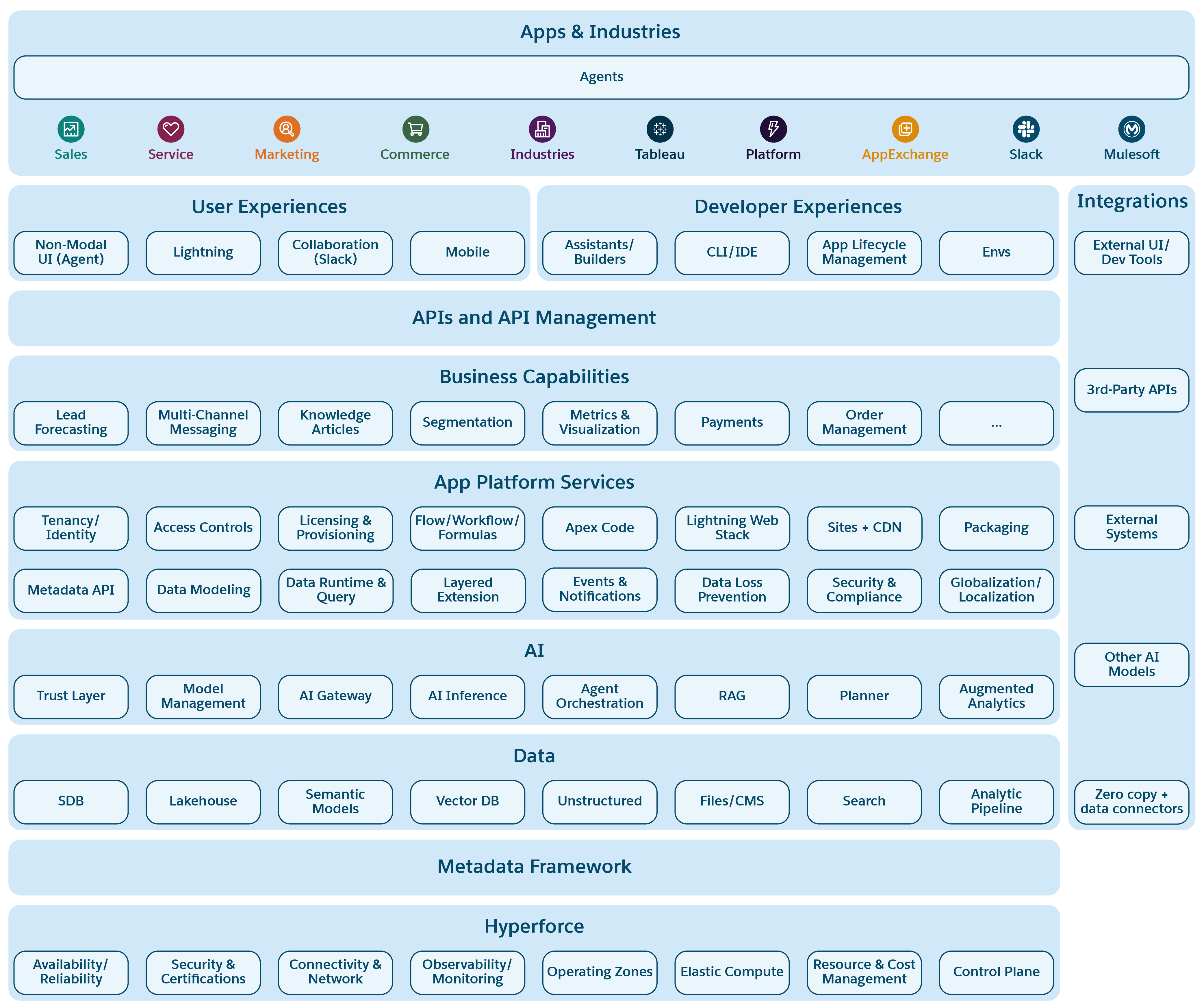
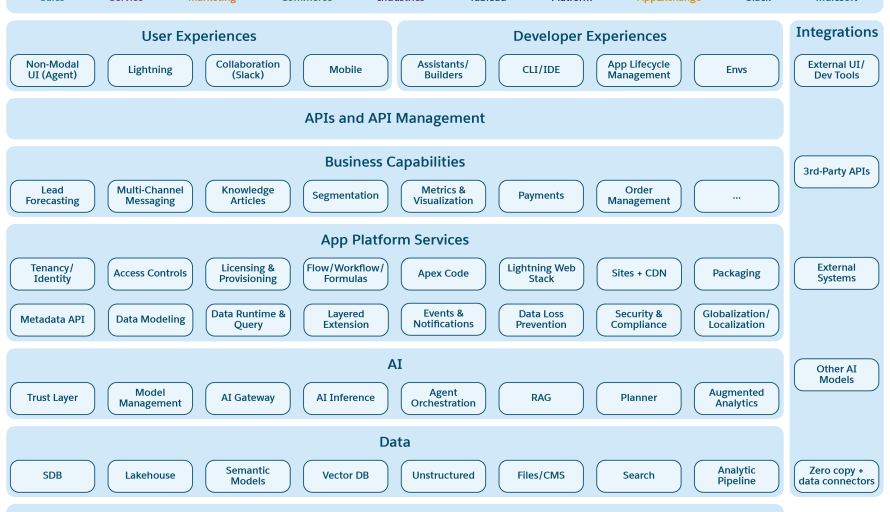
Architectural overview of the Salesforce technology stack.
As Salesforce expanded through new applications and acquisitions, what challenge emerged in maintaining a unified metadata approach across systems built on different architectures?
Salesforce has a strong, mature metadata foundation at the platform’s core, defining how organizations configure behavior, customize deterministic and agentic workflows, and evolve safely at scale. A cohesive metadata model, paired with semantic and ontological models on top of it, are key for agentic experiences grounded in each customer’s unique business context and highly personalized to each user.
The challenge emerges as the platform expands across new applications and acquisitions that bring distinct metadata strategies of their own. Mandating a single implementation that all services and acquisitions must align to would introduce unnecessary friction. At the same time, allowing our unified model to fragment, while easier in the short term, would negatively impact innovation, limit our ability to provide deeply grounded and personalized agentic experiences, and would make it harder for our customers to reason about their implementations. The goal must therefore be a coherent, platform-wide model that all services participate in, one that provides a unified view of metadata across the entire stack while also allowing our engineering teams leeway in choosing the implementation that works best for their needs.
As Salesforce grows, the Office of the Chief Architect defines architectural patterns and expectations for how metadata is represented, what its lifecycle looks like, and how it is consumed across systems. This establishes shared principles, allowing teams to align behavior and semantics even when underlying metadata implementations differ. This ensures metadata can continue to evolve independently within each application, while supporting a unified, cohesive view and behavior across the entire platform.
What constraints shaped the use of event-driven communication as the platform footprint expanded across independently evolving systems?
As Salesforce’s platform footprint expanded across clouds, regions, and independently evolving services, eventing and cross-system communication became a critical architectural pattern. At this scale, event-based communication is not merely about data delivery but about managing coordination boundaries, failure domains, and coupling between independently evolving systems. Choices regarding synchronous versus asynchronous interaction, event granularity, and dependency direction significantly impact scalability, reliability, and operability.
The Office of the Chief Architect works closely with engineering teams and senior architects to define architectural strategies, helping teams consistently make these tradeoffs. This includes establishing expectations for when asynchronous eventing is appropriate, how services should expose and consume events, and how communication patterns avoid hidden dependencies that limit independent evolution. The focus remains on patterns that remain stable as throughput increases and services scale across regions.
By grounding eventing and cross-system communication in shared architectural principles, engineering teams can design systems that scale without creating tight coupling or fragile coordination paths. This allows the platform to support higher throughput, more complex orchestration, and new execution models while remaining predictable, resilient, and easier to evolve over time.
How did the team balance long-term platform evolution with the need to support existing product behaviors and customer patterns?
As Salesforce’s customer adoption grew, customers increasingly built large, complex architectures that spanned multiple product lines, including Sales Cloud, Service Cloud, Marketing Cloud, Commerce Cloud, and other Salesforce products. Many operate highly customized environments with deep automation, extensive integrations, and multiple applications that evolve independently yet must continue to work together. At this scale, architectural change is constrained not only by backward compatibility but also by the emergent behavior of interconnected systems that customers rely on in production.
The Office of the Chief Architect focuses on understanding where these customer-driven architectures pressure-test the platform’s foundational assumptions. This includes identifying patterns where customization depth, integration complexity, or deployment scale amplify the impact of architectural change. Working closely with engineering teams, senior architects and customers, the team helps ensure platform evolution accounts for these system-level realities, rather than optimizing solely for new capabilities or assuming idealized implementations.
Balancing evolution with customer needs requires scaling architectural principles while also becoming more opinionated about how complex systems should design on the platform.The growing need for this kind of opinionated guidance is one of the reasons we re-launched the Salesforce Architecture Program, creating the foundation for clearer best practices that help customers with large deployments safely adopt advanced patterns, without undermining the stability of existing architectures as the platform continues to evolve.
What architectural gaps prompted the reboot of the Salesforce Architecture Program, and how does the Salesforce Architecture Center address them?
As organizations embrace Salesforce on a larger scale by evolving more complex architectures, new challenges arise beyond individual feature use. The transformation towards the Agentic Enterprise that many of our customers are undertaking adds both challenges and opportunities. When operating at scale, clients must analyze architectural tradeoffs, including determining where responsibilities lie, how systems integrate, and how design choices affect scalability, reliability, and long-term operability. Additionally, making the right trade offs can position IT organizations for increased agility, faster innovation, and lower cost to serve.
Documentation explains service and feature functionality. The Salesforce Architecture Center provides opinionated guidance for designing large-scale, complex, multi-system architectures that span multiple applications, integrations, and cloud environments. Instead of dictating implementations, the program focuses on helping clients understand architectural patterns, decision frameworks, and best practices relevant to complex deployments. This guidance aims to help clients design architectures that align with Salesforce’s foundational models, even with advanced customization and integration needs.
This centralized resource supports external enterprise architects and large organizations building sophisticated systems on the Salesforce product suite. By consolidating guidance and reinforcing it through education, the program empowers clients to confidently adopt advanced architectural patterns, ensuring their systems scale and evolve securely as needs and the platform grow.
Learn more
- Stay connected — join our Talent Community!
- Check out our Technology and Product teams to learn how you can get involved.