By Violet Gong, Gang Shu, and Shweta Joshi.
In our Engineering Energizers Q&A series, we highlight the engineering minds driving innovation across Salesforce. Today, we spotlight Violet Gong, Senior Director of Software Engineering. She leads the Revenue Orchestration team, who built the Sales Agent on Agentforce to autonomously manage CRM data and produced 1.04 million monthly recommendations for 13,000 sellers.
Explore how the team processed hundreds of thousands of opportunities within a strict nine-hour window daily and established frameworks to ensure AI-generated recommendations remain trustworthy, explainable, and secure before the system modifies CRM data.
What is your team’s mission in building the Sales Agent on Agentforce?
The team evolves CRM from a passive system of records into an autonomous system of actions, where raw engagement signals — emails, meetings, and research — are orchestrated into real-time revenue execution. The system reduces manual effort and improves data accuracy across CRM. This mission requires rethinking patterns where sellers log activities, update opportunity stages, and maintain next steps. Those manual tasks often lead to incomplete or stale data at scale.
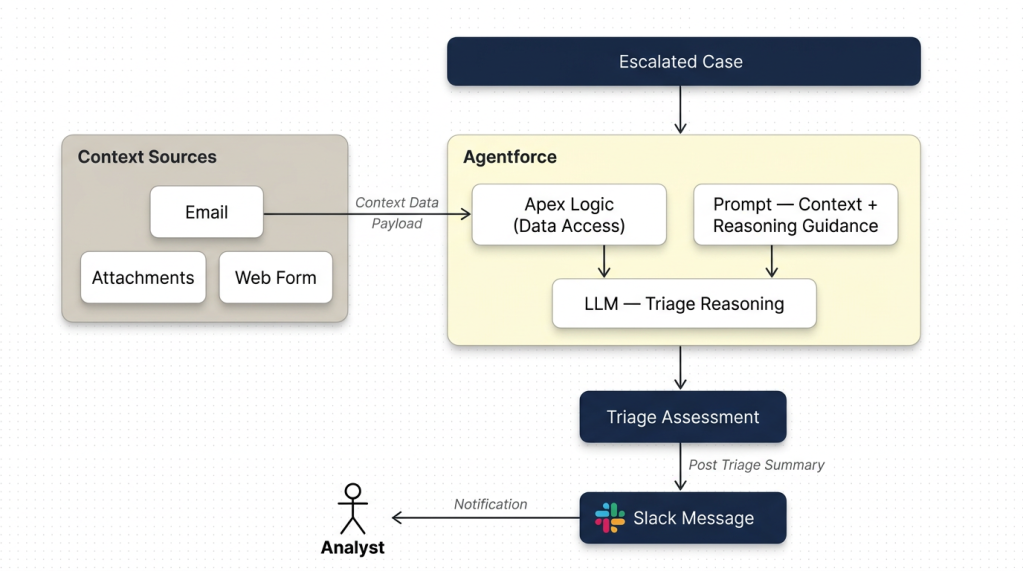
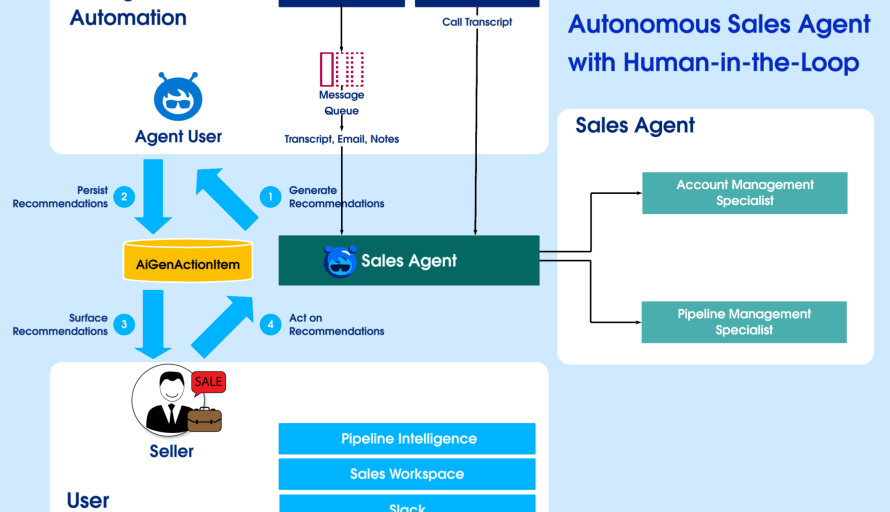
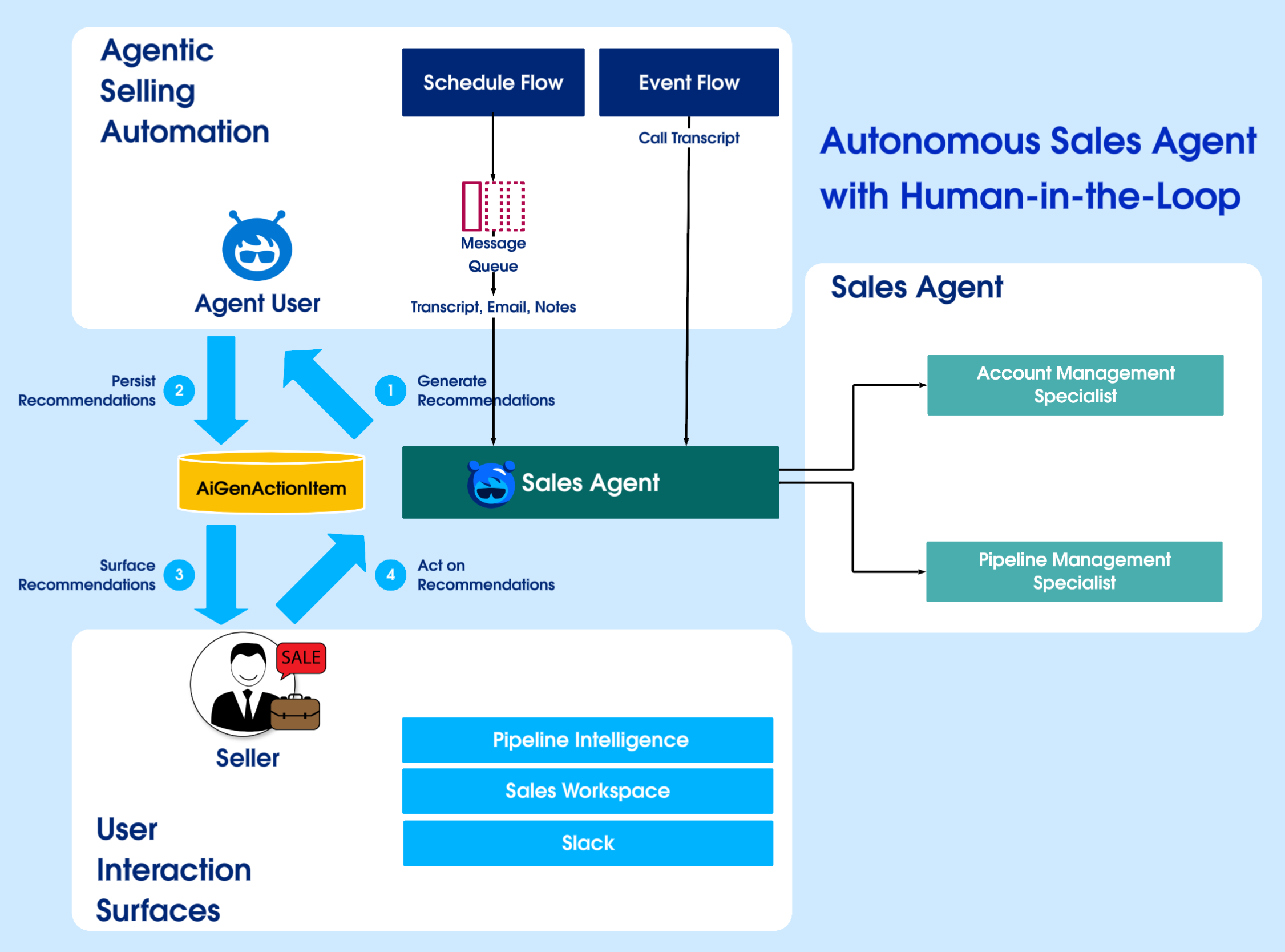
The team develops two core capability areas: pipeline management and account management. The systems continuously analyze activity signals, generate actionable recommendations, and safely apply updates within CRM. The team also ensures these capabilities meet enterprise requirements for scale, security, and trust. This allows organizations to adopt automation progressively, moving from human-in-the-loop workflows to fully autonomous operation.
Violet shares what makes Salesforce Engineering’s culture unique.
What scale challenges shaped the system architecture for processing hundreds of thousands of opportunities overnight with the Sales Agent’s AI-driven activity analysis?
The primary challenge involved scaling a proof-of-concept into a system capable of processing hundreds of thousands of opportunities during a fixed overnight window. Each opportunity requires synthesizing activity signals like calls and emails, which can result in up to 27,000 input tokens per invocation. To ensure updates reach sellers by the start of their day, all processing must finish within a nine-hour window.
Platform constraints, such as a limit of 300 requests per minute, made standard execution via Agent invocation impossible to use. The team solved this by introducing a message queue–driven architecture that separates orchestration from execution to manage high concurrency.
In addition to orchestration changes, the team optimized data retrieval by focusing on recent email threads and implementing a fast-fail mechanism for video call transcripts that triggers an immediate fallback to voice call transcripts. This narrowed scope reduced latency from 1.35 seconds to approximately 600 milliseconds, allowing the system to meet both throughput and performance targets.
Violet shares why engineers should join Salesforce.
What factors shaped how AI-generated recommendations are made explainable, secure, and safe to apply to CRM data?
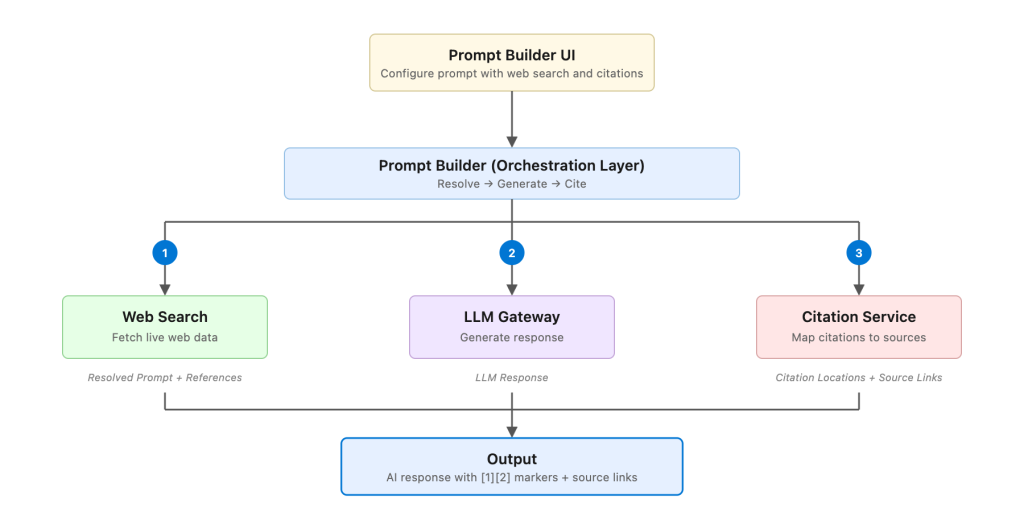
Trust remains critical because recommendations directly impact forecasting and revenue outcomes. Errors in stages or next steps propagate across dashboards and downstream systems. To prevent these issues, the system avoids black-box behavior by attaching explicit reasoning and citations to every recommendation. This allows users to trace outputs back to specific lines in transcripts, emails, or activity signals during production usage.
Security and access control require equal attention. The system operates with an elevated agent context during background processing to access necessary data. However, an additional access check runs before the system surfaces any recommendation. This step ensures the user has permission to view the underlying data. If permission is missing, the system withholds detailed recommendations to prevent unintended exposure.
These mechanisms — explainability, layered access control, and transparency — help organizations build confidence. They allow for a gradual transition from human-in-the-loop workflows to autonomous execution while maintaining strict governance.
What design considerations led to building a reusable AI-generated action framework that can be shared across multiple agents?
The team recognized early that recommendations should not depend on a single agent. Multiple agents often analyze the same data to generate different actions, such as updating fields, drafting follow-ups, or recommending quotes. A unified model prevents fragmentation in how the system generates, stores, and surfaces these actions.
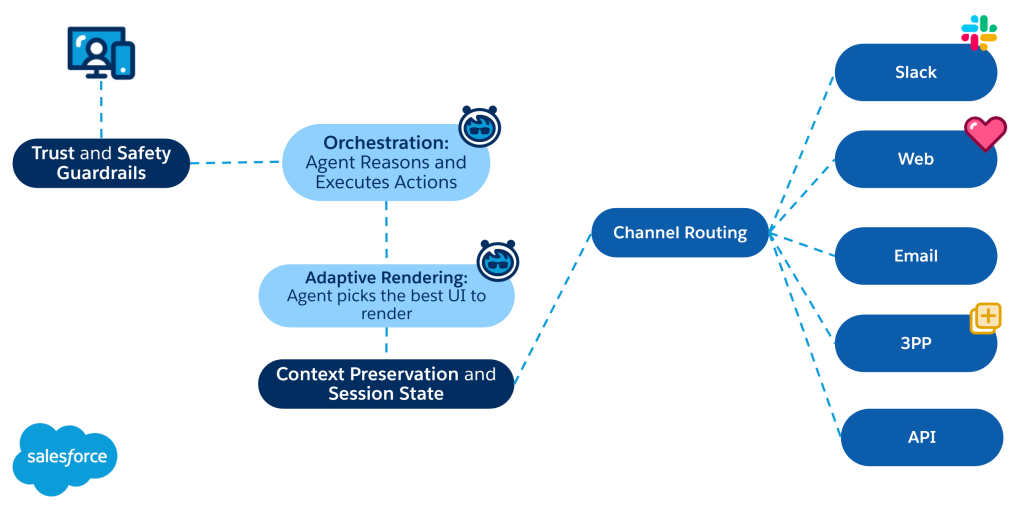
To solve this, the team introduced a persistent platform entity for AI-generated actions. This entity standardizes how the system handles all recommendations. Instead of writing directly to fields or maintaining separate structures, all agents store actions within this shared framework. This approach enables consistent APIs and uniform presentation across interfaces like CRM and Slack.
The design also supports extensibility. New agents and capabilities integrate without the need to redefine how the system represents or surfaces actions. This ensures consistency as the platform evolves.
What tradeoffs between time-to-market and extensibility influenced the decision to build a highly customizable, low-code architecture?
The team balances speed with long-term flexibility. A hard-coded implementation might accelerate release, but it fails to support the variability of enterprise sales processes. Instead, the team built a modular architecture using low-code and no-code capabilities to enable flexibility without sacrificing scalability.
Administrators define which opportunities the system processes. They customize grounding data sources beyond default signals and extend the system to populate additional fields based on specific sales methodologies. Organizations also incorporate external data sources for broader context.
This approach ensures the system adapts to different needs while maintaining a consistent architecture. It enables new use cases without fundamental changes, striking a balance between rapid delivery and extensibility.
What engineering challenges shaped how the Sales Agent operates autonomously in the background while maintaining accurate and reliable CRM data?
Operating as a background system requires continuous execution without user initiation while maintaining accuracy and consistency at scale. The system processes large volumes of data, applies updates correctly, and aligns with user expectations and organizational policies. This creates challenges around balancing autonomy with control.
To address this, the system supports both human-in-the-loop and autonomous modes. Organizations review and validate recommendations before enabling automatic updates. They gradually introduce autonomy at the field level based on sensitivity. This phased approach builds trust while maintaining control over critical data.
The system demonstrates significant impact in production deployments. It generates large volumes of recommendations and surfaces hundreds of thousands of actions to users. This contributes to a 75% reduction in time spent on manual updates. Scalability, trust, and configurability combine to maintain CRM data integrity at enterprise scale.
Learn more
- Stay connected — join our Talent Community!
- Check out our Technology and Product teams to learn how you can get involved.