For decades, enterprise software has been an imperfect approximation of how businesses actually work. No matter how carefully a process is modeled in rules and workflows, reality has a way of drifting: customers behave unexpectedly, exceptions pile up, priorities shift, and edge cases become the norm. In those moments, people have filled the gap — applying judgment where the system’s model stops matching what’s happening on the ground.
That approach scaled well when work was linear and responsibilities were neatly separated. But it starts to break down when organizations need automation that can continuously interpret situations, adapt in real time, and coordinate across interconnected teams like sales, service, and marketing.
Agentic reasoning changes the equation. Agents can assess context and choose actions dynamically, pushing more of that “human glue” into software. The catch is that the applications agents must operate still assume a human is doing the sense-making: intent is expressed indirectly, actions are exposed inconsistently, and context is fragmented across systems.
Closing this gap will take more than layering AI on top of existing workflows. It requires re-architecting the applications themselves — rethinking how we express intent, expose actions, and govern shared context — so enterprise software can evolve from systems of record into systems of action.
Why Deterministic Automation Breaks Under Agentic Reasoning
Traditional enterprise automation relies on the assumption that business processes remain fully specified from the start. Deterministic workflows provide repeatability and correctness because every possible transition is known ahead of time. However, this strength turns into a constraint when processes span multiple domains or require situational judgment – like when an exception to a rule occurs.
In many applications, critical business logic lives outside explicit control flows. Humans infer intent by interpreting screens and navigating exceptions, but agents lack access to that implicit context. Instead, agents require explicit contracts including preconditions, constraints, and defined outcomes. Attempting to use agentic reasoning without restructuring applications allows non-determinism to compromise necessary correctness.
The architectural solution involves combining deterministic workflows with agents rather than replacing one with the other. Core execution paths remain governed and predictable while agents reason within defined boundaries. This hybrid model allows agents to decide which actions to take while ensuring the actions themselves follow validated paths. This approach preserves reliability and enables adaptability across the enterprise.
Decomposing Business Intent into Agent-Operable Actions
Enabling agentic systems requires translating customer and operator intent into reliable actions. Most enterprise applications evolved around user interfaces and backend services rather than semantic capabilities. Making these capabilities accessible to agents requires decomposing applications into explicit actions that encode business intent, along with metadata that augments those actions.
These actions define what an operation does, when it applies, and which constraints exist. Agents invoke governed business capabilities with known outcomes instead of improvising against raw system primitives. This decomposition maps custom workflows and extensions into agent-operable constructs, which preserves existing investments. Applications maintain their original behavior while making intent explicit and machine-readable for agents.
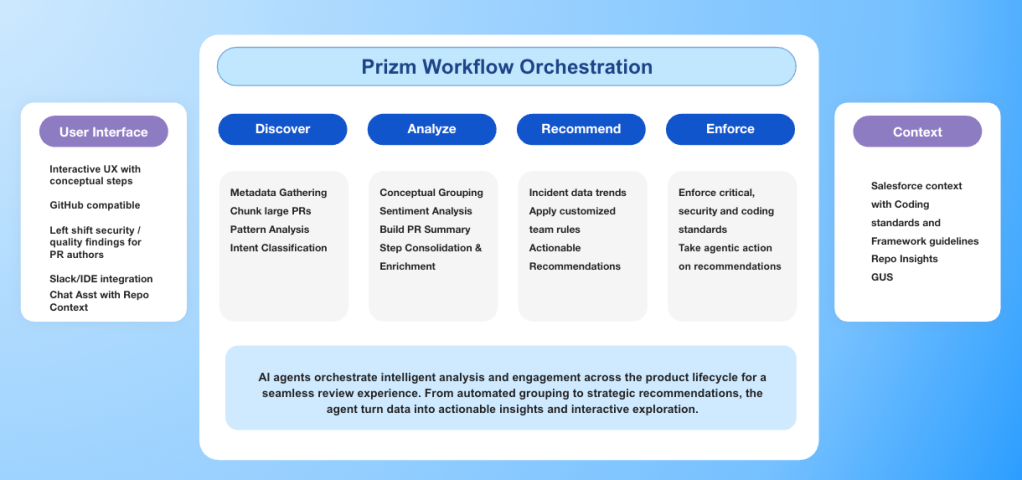
Context provides the foundation for this model. Agents receive structured views of business data, user roles, and state. The platform builds this context by extracting relevant information, balancing reasoning fidelity with latency and cost. This execution environment allows agents to act with awareness while remaining predictable and efficient.
From Events to Conversations Across Channels
Enterprise systems generate vast types and quantities of events, including order confirmations, shipping updates, and service alerts. Traditionally, these events functioned as one-way communications. An agentic model transforms every event into a potential conversational entry point.
Re-architecting applications for this shift requires unifying marketing communications, service conversations, and workflow automation into a single conversational fabric. Outbound messages now accept responses triggering reasoning or downstream actions. This setup removes the need for human intervention by default.
The architecture treats conversation state as a primary concern. Agents initiate, pause, or redirect interactions across channels while preserving continuity. Distilling prior exchanges into concise context allows conversations to flow naturally across email, messaging, and voice. This approach enables immediate issue resolution within the same interaction rather than deferring tasks to manual queues.
Orchestrating Agentic Systems at Enterprise Scale
Enterprise orchestration at scale involves managing a network of interdependent problems. Customer journeys span multiple domains with unique data models and constraints. Agents must recognize their position within these journeys and understand how actions in one area impact others.
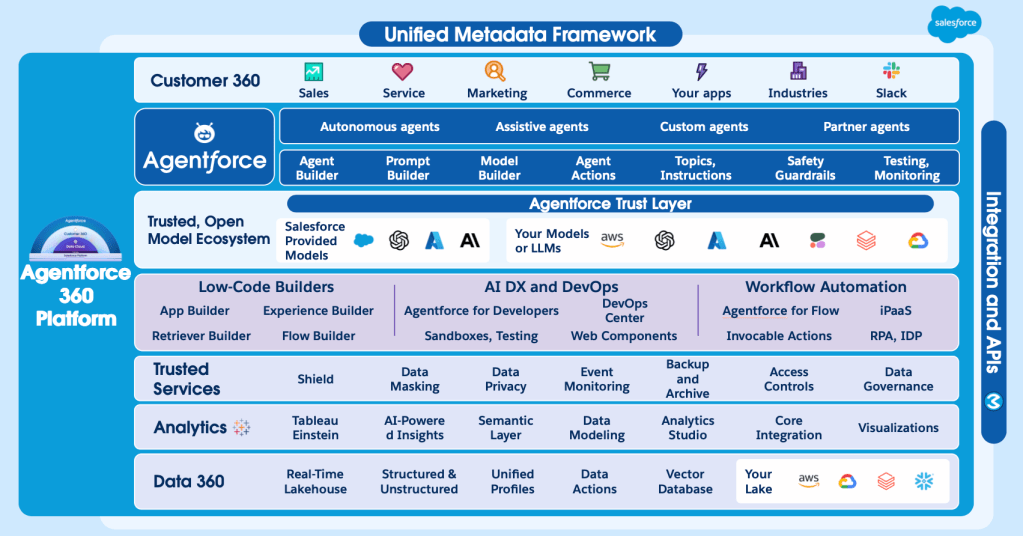
The Salesforce platform supports orchestration inside and outside agent reasoning loops. Transitions occur both synchronously and asynchronously. Standard routing patterns manage these steps by passing context between agents, workflows, and people. Some tasks require human approval while others function with full automation.
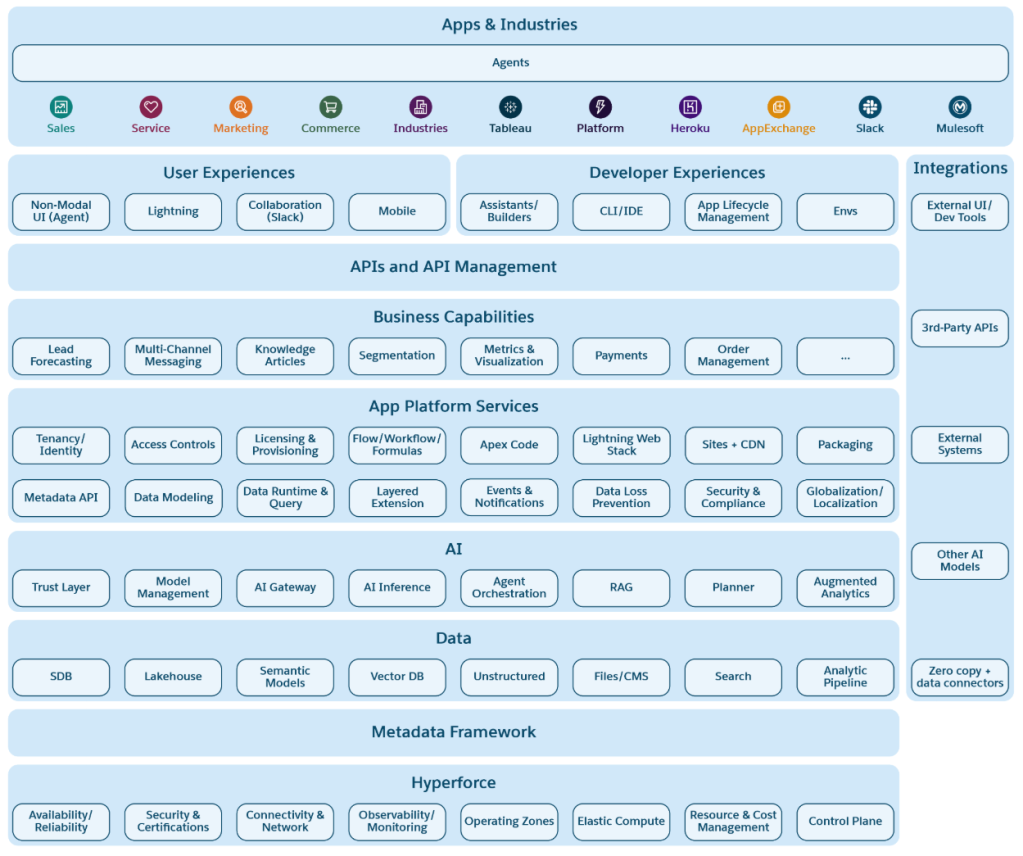
Currently, our Applications provide more than 15 domain-specific agents, supported by approximately 450 curated actions. Customers can customize and extend these agents — or create new ones — using thousands of available APIs as callable capabilities. They operate across enterprise surfaces like Slack and Teams, along with consumer channels such as SMS and WhatsApp.
Efficiency serves as a primary design constraint. Every interaction accounts for data access, reasoning, and execution. The system manages latency, data volume, and traffic patterns through careful decomposition and performance testing. This iterative approach ensures the architecture remains robust and responsive.
From Systems of Record to Systems of Action
Re-architecting enterprise applications isn’t about sprinkling AI on top of yesterday’s workflow engines — it’s about changing what the application is in an agentic world. Agentic reasoning expands what automation can handle, but only if the software is built to share intent, carry the right context, and collaborate through orchestration instead of forcing humans to bridge the gaps.
In practice, the re-architecture centers on four transformations:
- Actions: Applications expose real business operations as well-defined, governed actions an agent can safely invoke.
- Context: Systems provide context with enough fidelity — grounded in policies, state, and provenance — for agents to reason and choose correctly.
- Conversations: Every event becomes the start of a dialogue: clarify intent, handle exceptions, and converge on outcomes instead of failing workflows.
- Orchestration: Work shifts from one app “owning” a process to orchestrating a network of agents and services, passing context across boundaries without losing meaning or control.
Taken together, these changes turn enterprise software into a system of action: deterministic execution and adaptive reasoning coexist, coordination spans domains and channels, and reasoning scales without sacrificing governance or accuracy. For engineers, this is a new blueprint for composing applications — where actions are first-class, context is managed deliberately, and orchestration is built into the architecture rather than bolted on.
Learn more
- Stay connected — join our Talent Community!
- Check out our Technology and Product teams to learn how you can get involved.