In our Engineering Energizers Q&A series, we highlight the engineering minds driving innovation across Salesforce. Today, we feature Darryn Dieken, Chief Availability Officer, who directs engineering productivity, reliability, and AI-driven operational excellence across Salesforce, supporting over 200,000 engineering changes weekly across 25 Hyperforce regions.
Learn how his team unified fragmented tooling across diverse runtimes and frameworks, scaled development velocity after a surge in AI-powered coding tools, and built quality and review workflows — preventing downstream bottlenecks while maintaining trust and availability at a global scale.
What is your team’s mission enabling developer productivity while maintaining high availability, security, and cost-efficient trust at Salesforce?
Our mission enables thousands of engineers to build and ship high-quality software efficiently, upholding Salesforce’s foundational trust principles. We support the full development lifecycle, from developer tools to systems enforcing safe changes across 25 Hyperforce regions. This responsibility accelerates developer workflows and ensures global services run reliably across availability zones, tenants, and products.
Beyond productivity, the team drives reliability and operational excellence through AIOps, telemetry analysis, automated issue detection, and post-incident learning workflows. We support systems that help engineers understand faults faster, improve root-cause analysis, and ensure incident response processes scale proportionally to global load and traffic. These workflows connect development acceleration and production resilience.
Ultimately, we combine developer productivity, reliability, automation, and human-in-the-loop operational safeguards, ensuring velocity and trust increase together rather than competing.
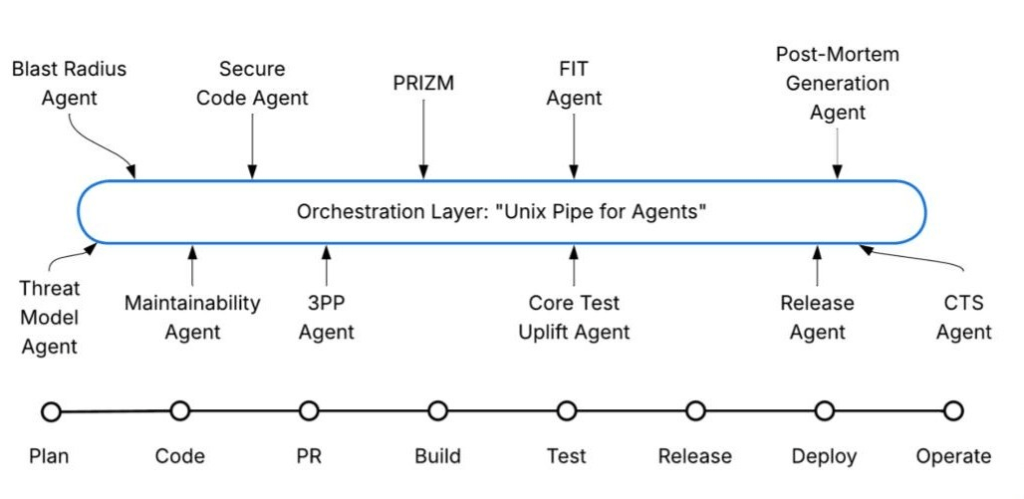
Salesforce builds AI agents into every part of the software development lifecycle.
What challenges emerged supporting thousands of engineers across diverse languages, runtimes, and workflows before AI-powered developer tooling scaled consistently across the organization?
Developer workflows at Salesforce once demonstrated significant variation across products and technology stacks. Building software with Java on Oracle, .NET on Windows, Python on Linux, and numerous internal platforms meant each required distinct workflows, development environments, and IDE support. No single tool initially met all these diverse requirements.
To ensure every engineer benefited from AI, the team implemented a portfolio of solutions, rather than a universal approach. Today, engineers select tools based on their workflow preference, yet remain aligned with internal standards. A few tools in this portfolio include:
- Cursor and Windsurf for AI-assisted code and tests generation
- Claude Code a CLI-based tool for automation and scripting workflows
The strategy proved effective: over 85%of eligible engineers now utilize AI-assisted development tools weekly. The challenge extended beyond tool diversity; it involved establishing unified coding standards, quality checks, and best practices across heterogeneous systems. This ensured velocity gains applied consistently rather than creating fragmented productivity.
What new bottlenecks surfaced as development velocity increased, particularly across test coverage, validation workflows, and deployment readiness?
AI accelerated development speed, increasing code in production by 30%. This surge created significant pressure on downstream processes. These included test coverage, validation workflows, code review throughput, and regional deployment. The bottleneck was not code creation; it was preparing that code for safe shipment. Without adjustments, senior engineers would have faced increased review loads. Long test cycles would have delayed features, and change sequencing across Hyperforce regions would have slowed.
Because more code shifts the burden downstream, the focus expanded from code generation to workflow orchestration. Automation now validates changes, increases testing coverage, and prioritizes issues early in the pipeline. This increases velocity without introducing operational risk.
What challenges drove the need for AI-assisted code review to prevent senior engineers from becoming bottlenecks as code volume expanded?
The increased development speed highlighted code review as a significant bottleneck. Senior engineers spent excessive time reviewing code, diverting them from system design, mentoring, and architectural tasks. Manual review processes would have expanded directly with code volume, negating the benefits of faster development.
To resolve this, the team developed AI-assisted review systems. These systems conduct initial analyses alongside engineers, quickly identifying issues. This allows human reviewers to concentrate on critical decisions that demand deep domain expertise, rather than routine checks. Humans maintain responsibility for final approvals and architectural judgments, ensuring continued trust and safety.
This division of labor — AI streamlining review preparation and engineers retaining decision-making power — avoids expert bottlenecks. It also upholds quality standards. Instead of replacing reviewers, AI empowers them to engage in more impactful technical work.
What obstacles emerged building AI-driven testing and coverage strategies ensuring unit, integration, and quality gates kept pace with accelerated development?
The acceleration in code generation strained test coverage pipelines, which previously scaled in proportion to development activity. Without proper reinforcement, insufficient unit or integration tests would introduce operational risks and raise the cost of detecting issues later in the product lifecycle.
To maintain speed, the team broadened its AI-assisted coverage strategies to include unit tests, integration tests, and validation workflows. Systems such as CodeGenie create initial frameworks, enabling engineers to concentrate on intricate scenarios and edge cases rather than repetitive manual tasks. Ambient code coverage agent helps ensure that newly generated code arrives with adequate coverage, preserving quality as development velocity increases.
This method ensures coverage aligns with code output. It eliminates the need for teams to compromise between speed and reliability. Engineers retain responsibility for accuracy and systemic validation, while AI expedites foundational work.
What risks must be mitigated to prevent generative or reasoning AI from making autonomous production decisions without human oversight?
While AI significantly enhances developer productivity, testing, and operational workflows, we do not permit generative or reasoning AI to independently alter production systems. Many AI engines lack complete determinism, meaning identical inputs do not consistently produce identical outputs. In live production settings, this unpredictability could lead to detrimental changes, such as scaling down resources instead of scaling up, or deleting clusters instead of repairing them.
Instead, AI assists engineers by expediting operational responses rather than directly executing changes. AI supports the analysis of logs and telemetry to identify issues more quickly, prepares remediation steps, and suggests actions based on historical patterns and system behavior. These systems increasingly help pinpoint incidents, propose probable root causes, and automatically generate potential fixes that engineers can review, validate, and implement.
Human operators remain responsible for decisions impacting live systems. As AI models demonstrate consistent behavior across more operational workflows, the degree of automation might increase. However, production changes will always require explicit human approval. This strategy ensures AI enhances reliability and response speed while maintaining trust, safety, and operational control.
Learn more
- Stay connected — join our Talent Community!
- Check out our Technology and Product teams to learn how you can get involved.